
Dr. Nathan Van Schmidt Presentation Summary
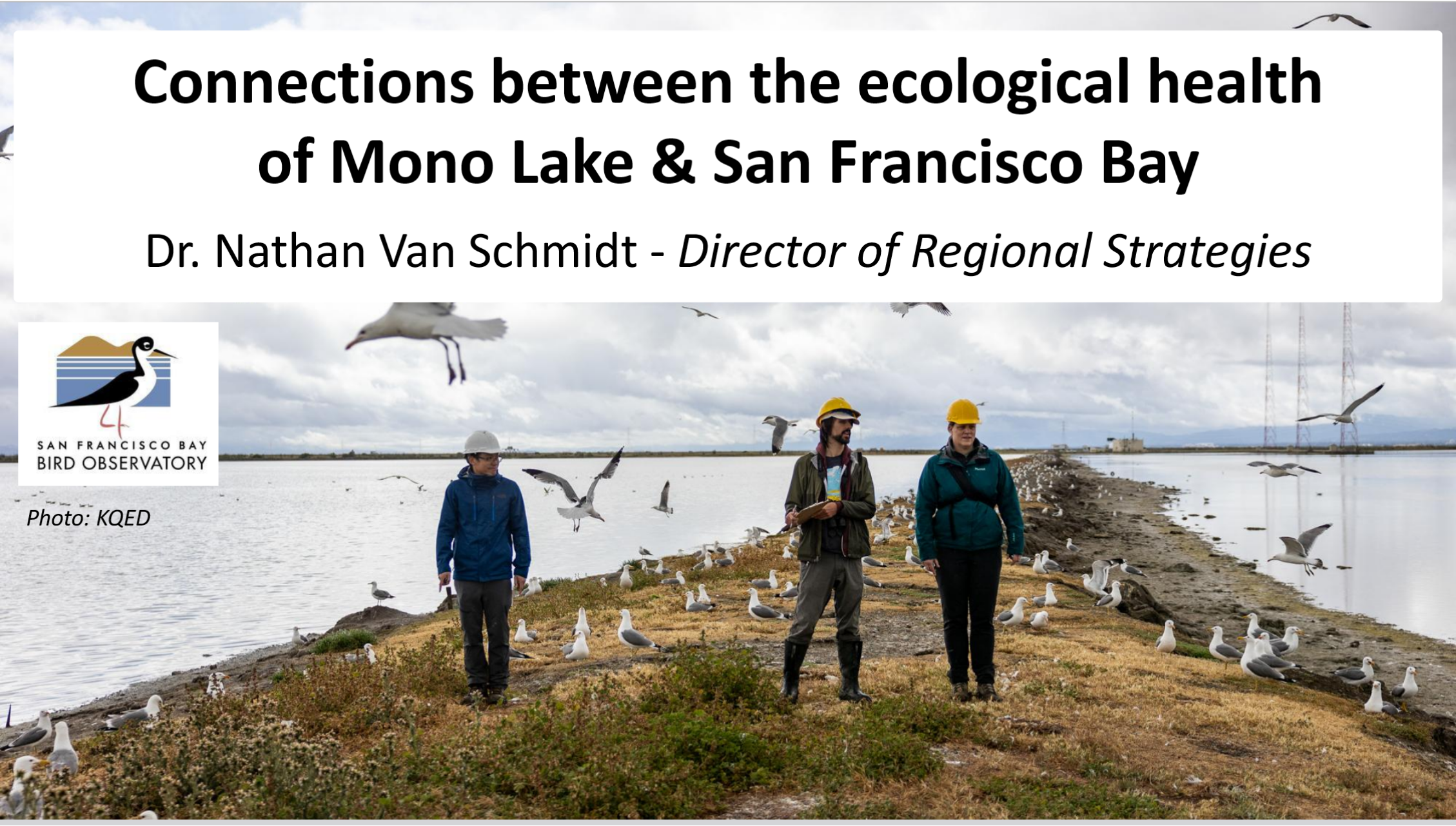
This presentation examines the ecological connections between Mono Lake and San
Francisco Bay through the lens of California Gull population dynamics. Following the
abandonment of traditional nesting colonies on Mono Lake’s Negit Island in the early
1980s, California Gulls established breeding colonies in South San Francisco Bay,
where the population grew rapidly and became a significant predator of several
threatened and declining waterbird species.
The presentation will explore how management efforts to reduce gull-related impacts on
species such as the Western Snowy Plover, California Least Tern, American Avocet,
and Black-necked Stilt have altered population trajectories, while also creating new
conservation challenges. As California Gull numbers at Mono Lake have declined and
the South Bay population has become the largest in California, resource managers are
increasingly faced with balancing competing conservation objectives across
interconnected ecosystems.
The discussion will also examine broader implications for migratory bird conservation,
including substantial declines in Wilson’s Phalaropes, Red-necked Phalaropes, and
Bonaparte’s Gulls within the South Bay. These trends highlight the complex ecological
linkages among Mono Lake, San Francisco Bay, and the Pacific Flyway, and
underscore the importance of understanding how changing conditions at Mono Lake
may influence bird populations and conservation outcomes elsewhere in California.