

Meeting Type
Description
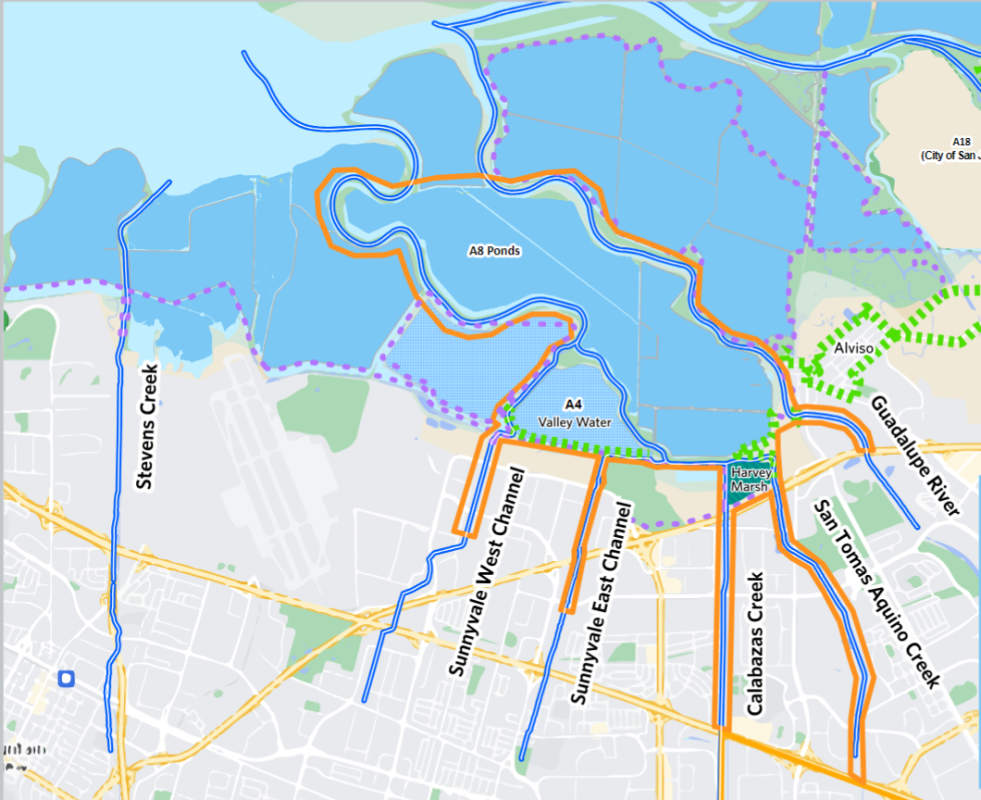
Learn how creek flows and sediments can benefit restoring tidal marshes from Michael MacWilliams of FlowWest, who has modeled hydrodynamics where the Calabazas and San Tomas Aquino creeks adjoin the salt ponds in northern San Jose. His work informs Valley Water’s project to connect those creeks with an Alviso pond in the Restoration Project. That project, the Calabazas/San Tomas Aquino Creek-Marsh Connection Project, would be the first in the South Bay to connect creeks with marsh, with a primary aim of increasing natural sediment supply to deeply subsided salt ponds to help restore tidal marsh while reducing flood risk.
This presentation, "Building ecosystem resilience through reconnecting sediment supply from creeks to tidal wetlands," introduces the project and some of the modeling tools supporting it. Hydrodynamic and sediment transport modeling was used to evaluate alternative options and to predict the erosion and deposition changes that options might produce within the restoration area. Marsh accretion modeling can estimate the development of tidal marsh and transitional habitats over a 50-year horizon to assess whether the restored habitats are resilient and sustainable in the face of climate change. Together, these analyses assess in a detailed way the potential for the project to support future tidal marsh habitat development at Pond A4 in the Alviso complex of the U.S. Fish and Wildlife Service's Don Edwards San Francisco Bay National Wildlife Refuge.
- See and download presentation slides
- See video of presentation
- See chat questions, comments, and link
Speaker Bio: Dr. Michael MacWilliams is a Principal Engineer and Partner at FlowWest. He has been providing environmental consulting services in the Bay Area since 2001. His Stanford University doctoral research focused on the application of detailed 3D hydrodynamic models to flow in river channels and on floodplains to improve river restoration project design and implementation. He has also developed and applied 3D hydrodynamic, wave, salinity, temperature, sediment transport, and morphologic models in large estuarine systems including San Francisco Bay and Chesapeake Bay. Dr. MacWilliams has authored or co-authored over 26 publications related to hydrology, hydraulics, sediment transport, river channel and floodplain restoration, geomorphology, estuarine physics, fisheries, and aquatic habitat. He is a recipient of the Lorenz G. Straub Award (2004) and the Hugo B. Fischer Award (2023).
Scientific Question: This research will help the Restoration Project answer a central scientific question in its Adaptive Management Plan under the topic of Sediment Dynamics:
Is the accretion rate of the restored ponds sufficient to reach vegetation colonization elevations?
Lunch and Learn Science Speaker Series
This presentation is the last in the 2024-25 series hosted by the South Bay Salt Pond Restoration Project. The aim of the series is to focus on science and adaptive management done in support of or in collaboration with our Restoration Project as well as relevant outside work. Speakers discuss research, modeling, and monitoring efforts and how Restoration Project managers are using science to inform decisions about restoration, flood risk management, and public access.
| Attachment | Size |
|---|---|
| Chat: Questions, comments, links (167.01 KB) | 167.01 KB |